
Support for research on PFAS in neighborhoods surrounding Deer Isle-Stonington High School was provided by the National Institute of Environmental Health Sciences, National Institutes of Health, grant number P30 ES000002, via a pilot project grant from the Harvard Chan NIEHS Center for Environmental Health to MDI Biological Laboratory. The Shultz Fund provided additional support.
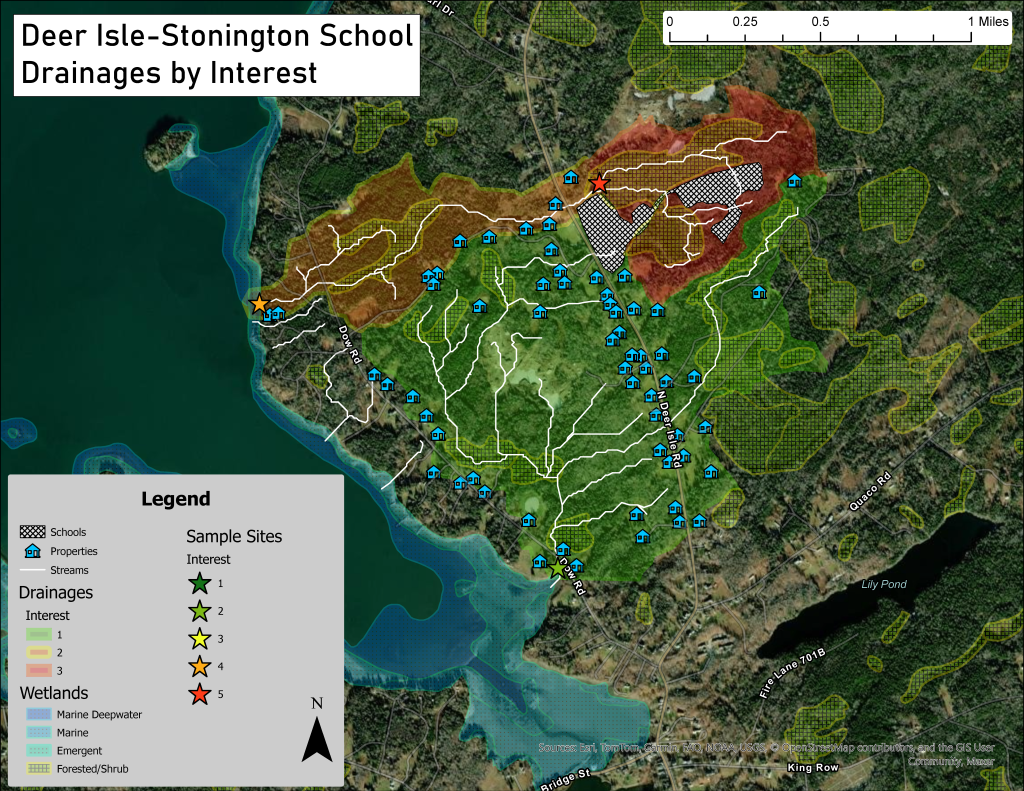
Below is a predictive map of potential sampling areas around Deer Isle-Stonington High School based on surface water flow. Houses in the green area may be at the greatest risk if PFAS contamination of groundwater at the high school has interfaced with surface water. MDI Biological Laboratory is leading the effort to collect preliminary data and submit grants in collaboration with local partners, including the Town of Deer Isle, Healthy Island Partners, the University of Maine, and Sunrise County Economic Council.
Timeline
November 2024
Flash funding from Harvard’s T.H. Chan School of Public Health to develop a pilot study of PFAS surface and groundwater contamination around Deer Isle Stonington High School to 1. Validate predictive models of PFAS transport in coastal watersheds and 2. Identify and educate private well owners about potential PFAS contamination of drinking water.
January 2025
MDI Biological Laboratory staff attended the annual Winterfest celebration at Deer Isle-Stonington Elementary School on January 17, 2025 to share information and get homeowners to sign up for well water testing for PFAS.
February 2025
MDI Biological Laboratory staff sampled private wells for analysis of 28 PFAS at Maine Laboratories. The results will help inform grant proposals supporting detailed modeling, additional sampling, and community engagement.
March 2025
Grant proposal submitted to Environmental Justice for New England to support well testing, environmental testing, community engagement, and curriculum development.
May 2025
The Environmental Justice for New England (EJforNE) Team announced the termination of their Environmental Protection Agency (EPA) funding, totaling $60 million, for the Region One Thriving Communities Grantmaking Program (TCGM). “These funds for EJforNE were approved by Congress, after rigorous review by the EPA, as investments in rural, urban, and Tribal communities across New England to address environmental hazards, climate resiliency, and energy justice, with a vision for building livable and healthy communities for all. Additionally, these funds would have supported the growth of a sustainable, community-driven environmental justice movement to counter historical disinvestment in communities across New England.
At the time of grant termination, they were poised to announce the first round of grant funding to communities. They received almost 400 applications, proposing projects for stormwater planning, flood resilience, sustainable farming, clean energy, tree planting, PFAS/water quality testing and education, transportation access, extreme heat mitigation, air quality monitoring, youth job training, and more.