
Support for research on PFAS in the neighborhood surrounding MDI High School was provided in part by the National Institute of Environmental Health Sciences, National Institutes of Health, grant number P30 ES000002, via a pilot project grant from the Harvard Chan NIEHS Center for Environmental Health to MDI Biological Laboratory. The Shultz Fund provided additional support.
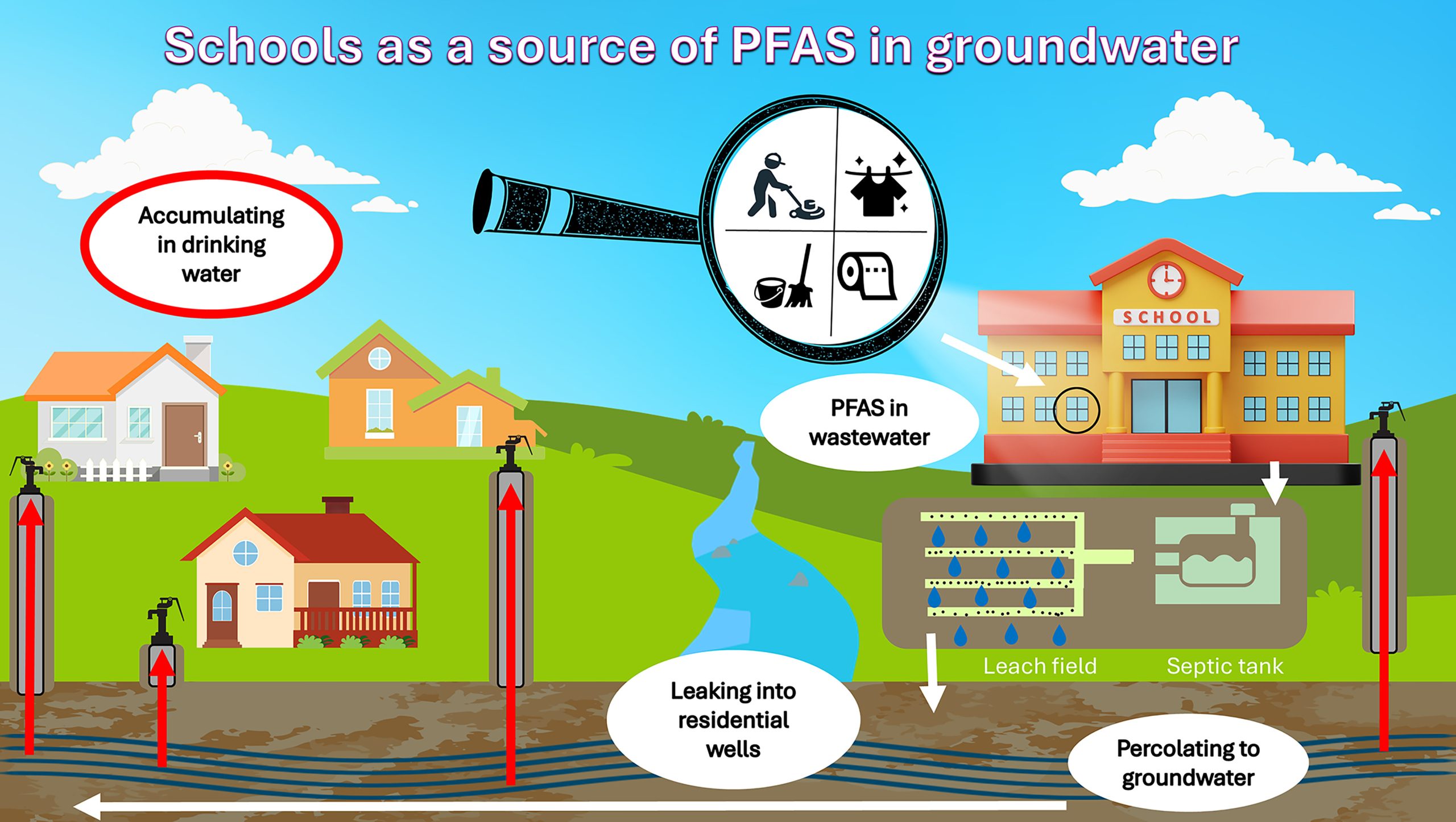
Schools can be a source of PFAS contamination in rural communities. In 2023, researchers at MDI Biological Laboratory began testing tap water samples from households near MDI High School, which was discovered in 2022 to have 85 ng/L PFAS in its drinking water. Elevated PFAS was discovered in most of these homes. The image below illustrates how schools with septic systems that leach contaminants into the groundwater can contribute to the PFAS problem in rural communities (from Moran Sosa et al., Environmental Health Perspectives, Volume 132, Issue 12, 2024).
Like other high schools in Maine, MDI High School tested its drinking water for PFAS in the summer of 2022. Neighbors became concerned that their wells might also be contaminated with PFAS. One homeowner had a test done on their drinking water and discovered PFAS levels just below the Maine standard. In the summer of 2023, the homeowner invited Community Environmental Health Laboratory staff members to attend a public meeting at the high school to learn more about the issue. Other neighbors attended the meeting and requested assistance in testing their drinking water for PFAS. Working in partnership with Maine Laboratories in Norridgewock, ME, the project team devised a drinking water sample collection protocol, obtained samples from multiple homes, and determined that the high school was the likely source of PFAS in neighboring wells. The timeline of events is detailed below.
Timeline
Below are milestones in the Community Environmental Health Lab’s effort to understand and address PFAS contamination of private wells and the surrounding environment of MDI High School in Bar Harbor, Maine. The culmination of this effort was a published research letter in the NIEHS journal Environmental Health Perspectives by Moran Sosa et al. in December 2024. There are ongoing efforts to understand the potential movement of PFAS in the local coastal environment.
August 2022
PFAS is discovered in MDI High School well
February 15, 2023
The state’s first commercial laboratory for PFAS testing, Maine Laboratories, opens in Norridgewock, Maine
May 15, 2023
MDI High School Community Meeting- names and addresses collected for shipping PFAS test kits
June-July 2023
Maine Laboratories PFAS test kits were distributed to four neighbors.
July 20, 2023
Meeting of the MDIHS neighbors with the Community Environmental Health Lab at MDI Biological Laboratory. The need for additional maps and centralized sample collection was identified.
July 28, 2023
Local Interactive Map Created The Community Environmental Health Lab’s GIS consultant made an interactive map to aid community conversations and understanding of the PFAS issue on MDI.
August 2, 2023
Jane Disney met with Michael Zboray, the superintendent of schools, and discussed Tremont School’s drinking water PFAS level (ME-6 PFAS – 19.9 ppt).
August 21, 2023
The Community Environmental Health Lab and MDI neighbors attended a follow-up high school meeting and learned about additional sample results at the high school. These data (PFAS results of soils, surface water, groundwater, and high school effluent) have been added to the interactive map.
August 22, 2023
DEP was informed of the results of the well testing in a neighborhood near MDI High School. They opened an investigation and re-sampled homeowner wells that had elevated PFAS.
August 23, 2023
The Bar Harbor Story published an article on the high school PFAS issue and alerted the public for the first time to the Tremont Consolidated School issue.
September 7, 2023
Meeting with high school teachers at MDIHS in September to begin planning a PFAS curriculum for students
October 18, 2023
The Community Environmental Health Laboratory presented a poster at the Acadia National Park Science Symposium “A Community-Engaged Research Approach to Address Impacts of Rural School PFAS Contamination on Neighborhood Wells”
October 2023
DEP communicated it has resampled drinking water from two homes near MDIHS with the highest PFAS levels and confirmed that they have >20 ng/L PFAS and will be coordinating the installation of carbon filtration systems and most likely conducting additional sampling in the area. April Bledsoe in DEP’s Division of Remediation was assigned as project manager.
March 2, 2024
We met with the Mt. Desert Shellfish Committee to discuss the submission of a Davis Conservation Foundation Grant to study the downstream impacts of PFAS-contaminated groundwater and surface water on Somes Sound.
February 1, 2024
PFAS Dr. Richard Hilliard, Environmental Engineer, joined the Community Lab as a postdoctoral research associate to work on the PFAS issue on Mt. Desert Island
March 28, 2024
Community Environmental Health Lab presented a poster at the Maine Sustainability and Water Conference, “A Community-Engaged Research Approach to Address Impacts of Rural School PFAS Contamination on Neighborhood Wells”
April 1, 2024
Start date of a Pilot Grant from the Harvard T.H. Chan School of Public Health to follow up with MDI High School and Tremont PFAS testing efforts.
April 10, 2024
EPA sets limits for 6 PFAS in drinking water. Limits (MCLs): PFOA & PFOS: 4.0 ppt. PFHxS, PFNA, HFPO-DA: 10 ppt. Each PFAS mixture: a Hazard Index of 1
June 1, 2024
Davis Family Foundation Grant for “Stemming the Tide of PFAS” project to study PFAS in coastal environments
June 6, 2024
Launch of collaboration with Bigelow Laboratory to study PFAS in coastal environments, including Somes Sound (downstream of MDI High School) and Bass Harbor (downstream of Tremont School).
November 12, 2024
Harvard T.H. Chan School of Public Health NIEHS Center supplemental funding to the April 1st pilot award leading to a study of the community around Deer Isle-Stonington High School.
December 3, 2024
Publication of Examining Potential PFAS Contamination of Private Wells from a High School in Rural Maine in Environmental Health Perspectives by Ludwin Moran Sosa et. al.