
The cool waters of the Gulf of Maine are critical to the Pine Tree State, bringing millions of vacationers every year and supporting habitat for the diverse aquatic life that represents a significant part of Maine’s culture, history, and current economic output. We need to protect the Gulf of Maine from contamination with per- and polyfluoroalkyl substances (PFAS, sometimes called ‘forever chemicals’)
PFAS are long-lasting surfactants that have been used widely since the middle of the twentieth century. These forever chemicals are a concern because exposure to them is associated with decreased birth weight, impaired neurodevelopment, increased risk of cerebral palsy, miscarriage, preterm birth, immunosuppressive effects, childhood behavioral problems, altered puberty timing, hypertension, disruption of thyroid signaling, and microbiome disruption (Hagstram et al., 2021).
They can be found in the blood serum of an estimated 98% of adults in the United States (Calafat et al., 2007). The European Food Safety Authority estimates that more than 86% of PFAS exposure from the diet may be due to seafood consumption (Shrenk et al., 2020). However, only 9% of studies reviewed in a recent meta-analysis of PFAS in shellfish pertained to North America (Giffard et al., 2022).
The Community Environmental Health Lab at MDI Biological Laboratory has identified rural schools (with private septic systems and wells) as possible sources of PFAS in the drinking water wells of surrounding properties (Moran Sosa et al., 2024). We track PFAS sources by correlating chemical profiles between water samples from different sites. Each chemical profile includes varying concentrations of 28 individual chemicals. Many rural schools in our state are very close to the shore, and the impacts of contaminated runoff from these sites on the Gulf of Maine have yet to be studied. Two schools we have identified drain into two important marine areas, a tidal flat in Somes Sound (Figure 1A) and Bass Harbor Marsh, which flows into Bass Harbor (Figure 1B). This unique estuarine system is especially significant as a site for the gathering of sweet grass by native communities (Greenlaw, 2023).
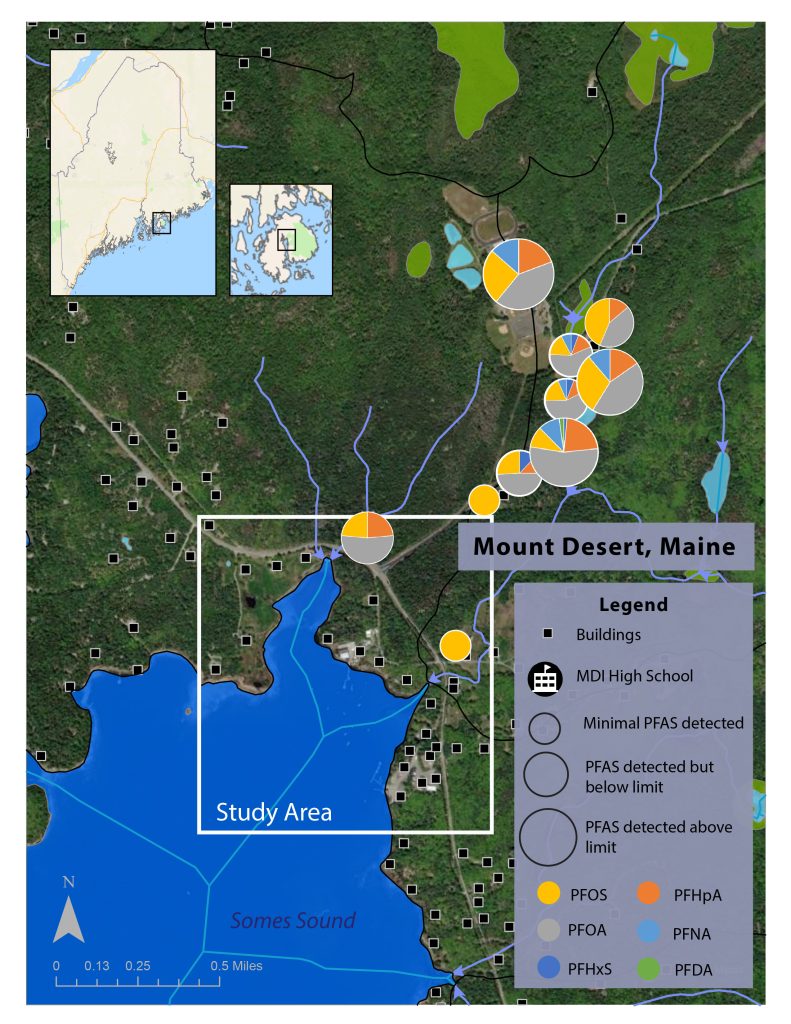
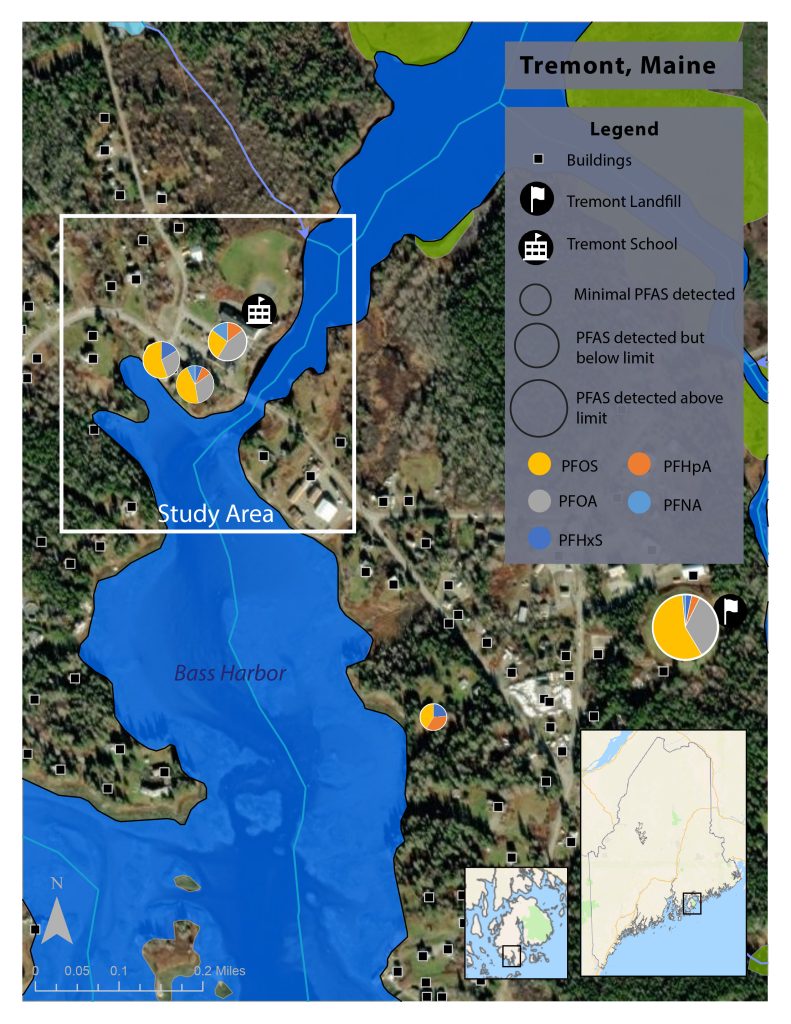
Figure 1. The pie charts in these maps of Mount Desert and Tremont, Maine, depict six regulated PFAS chemicals: PFOA, PFOS, PFNA, PFHxS, PFHpA, and PFDA. (A) The distribution of chemicals is similar when comparing the MDI High School drinking water test results with those from surrounding houses. (B) The distribution of chemicals is similar when comparing Tremont School drinking water test results with surrounding houses and different when comparing these sites with the distribution of chemicals at the closed landfill. Our study areas are outlined in white.
Project Personnel
Dr. Jane Disney is an Associate Professor of Environmental Health at MDI Biological Laboratory. Over the last two decades, she has directed the activities of the Community Environmental Health Laboratory, engaging people of all ages in preserving and improving the water quality of Mt. Desert Island. Her work has ranged from eelgrass restoration to red tide monitoring and bacterial tracking in watersheds to ensure healthy clam flats and beaches. She has served on the Bar Harbor Marine Resources Committee and the Maine Shellfish Advisory Council. She oversees the All About Arsenic project across Maine and New Hampshire, engaging teachers and students as citizen scientists in collecting well water samples for analysis of arsenic and other toxic metals. Most recently, she has been investigating PFAS in schools and the impact of PFAS-contaminated groundwater on surrounding communities.
Dr. Rich Hilliard is a post-doctoral research associate who has recently started in Dr. Disney’s lab. He is an Environmental Engineer who did his graduate research at Oregon State University on PFAS reduction using plants to remove PFAS pollutants from stormwater. He has demonstrated that plants can mitigate concentrations of PFAS in surface runoff and is interested in pursuing mitigation strategies with communities that are contending with groundwater and surface water PFAS pollution issues.
Dr. Christoph Aeppli, a marine chemist at Bigelow Laboratory, has documented PFAS concentrations in coastal waters across 30 stations from Portland to Machias. In a poster presentation at the Maine Fisherman’s Forum in 2024, Dr. Aeppli presented data indicating that different areas of the Gulf of Maine have unique profiles of contamination.
New Coastal Collaboration
Researchers from the Bigelow Laboratory and MDI Biological Laboratory are working to determine the relationship between PFAS contamination on land and potential runoff to coastal areas by measuring PFAS in ocean water, sediment, and shellfish. This partnership will merge the growing expertise of the Community Environmental Health Lab in tracking terrestrial sources of PFAS contamination with the comprehensive survey of PFAS contamination that Dr. Aeppli is conducting in the maritime waters of the Gulf of Maine. Mt. Desert Shellfish Committee members voted unanimously to support our efforts to track PFAS in Somes Sound on Mt. Desert Island. Together with Dr. Aeppli and the cooperation of the towns of Tremont and Mt. Desert, our work will provide a better understanding of how PFAS moves through coastal watersheds and impacts marine environments and will bring us closer to local solutions.
References
Calafat et al., “Polyfluoroalkyl Chemicals in the U.S. Population.” Environmental Health Perspectives 2007 Nov; 115(11): 1596–1602 doi: 10.1289/ehp.10598
Giffard, N. G.; Gitlin, S. A.; Rardin, M.; Petali, J. M.; Chen, C. Y.; Romano, M. E. Occurrence and Risks of Per- and Polyfluoroalkyl Substances in Shellfish. Curr Envir Health Rpt 2022, 9 (4), 591–603. https://doi.org/10.1007/s40572-022-00379-z.
Greenlaw, Suzanne. “Mobilizing Indigenous Research Methodologies and Wabanaki Knowledge in Biophysical Research to Restore Wabanaki Sweetgrass Harvesting in Acadia National Park and Identify Basket Quality Black Ash Habitat for Emerald Ash Borer (Agrilus planipennis) Preparedness.” (2023). DigitalCommons@UMaine.
Hagstrom, Anna L., Paul Anastas, Andrea Boissevain, Alexandre Borrel, Nicole C. Deziel, Suzanne E. Fenton, Cheryl Fields, et al. “Yale School of Public Health Symposium: An Overview of the Challenges and Opportunities Associated with per- and Polyfluoroalkyl Substances (PFAS).” Science of The Total Environment 778 (July 2021): 146192. https://doi.org/10.1016/j.scitotenv.2021.146192.
Schrenk, D.; Bignami, M.; Bodin, L.; Chipman, J. K.; del Mazo, J.; Grasl‐Kraupp, B.; Hogstrand, C.; Hoogenboom, L. (Ron); Leblanc, J.; Nebbia, C. S.; Nielsen, E.; Ntzani, E.; Petersen, A.; Sand, S.; Vleminckx, C.; Wallace, H.; Barregård, L.; Ceccatelli, S.; Cravedi, J.; Halldorsson, T. I.; Haug, L. S.; Johansson, N.; Knutsen, H. K.; Rose, M.; Roudot, A.; Van Loveren, H.; Vollmer, G.; Mackay, K.; Riolo, F.; Schwerdtle, T. EFSA Panel on Contaminants in the Food Chain (EFSA CONTAM Panel) Risk to Human Health Related to the Presence of Perfluoroalkyl Substances in Food. EFS2 2020, 18 (9). https://doi.org/10.2903/j.efsa.2020.6223.
Funded with support from the Davis Conservation Foundation